Is Your Electrical Service Big Enough for What You Actually Run
A panel that was fine for decades can fall short the moment a house adds central air, a hot tub, or a workshop full of tools.
September 23, 2026 · 3 min read
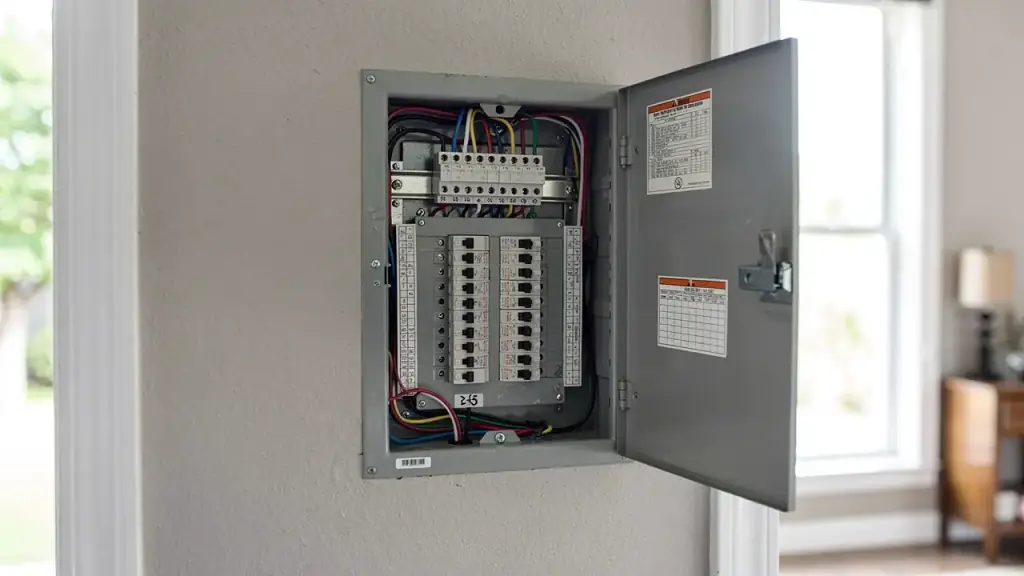
A lot of the older farmhouses and capes out here were wired for a house that ran a furnace, a refrigerator, and some lights. Nobody was thinking about central air, a hot tub, an electric range, and a workshop full of power tools when that panel went in.
The service upgrade conversation almost always starts the same way: something new got added to the house, and the electrical system that was fine for decades suddenly isn't.
Signs the service is undersized
- Breakers trip when two things run at once that used to run fine separately
- Lights dim or flicker when the air conditioner or a large appliance kicks on
- Outlets or the panel itself feel warm to the touch
- The panel is already full, with no room to add a circuit for a new addition or a workshop
Any one of those on its own might not mean much. A couple of them together usually means the service is working harder than it was built for.
It helps to picture the panel the way it actually works: every circuit in the house shares one connection back to the utility, and that connection has a limit. When the house was built with a furnace, a refrigerator, and some lights, that limit was never tested. Add central air, an electric range, a hot tub, and a couple of home offices full of computers and monitors, and the same connection is now being asked to carry a load nobody planned for when the wiring went in.
What changes trigger the upgrade
We see this most on old construction that's been added onto over the years. Central air conditioning is the big one. So is a hot tub, a detached workshop or garage with its own subpanel, an electric range replacing gas, or a generator getting added to a system that was never built with the extra load in mind. None of that is unusual. It's just more than the original service was sized for.
A workshop is its own special case. A table saw, a compressor, a welder, and shop lighting all running off a single circuit that used to feed a garage door opener and not much else is a common way to find the limit of an old service the hard way, usually mid project. We size a subpanel and the feed to it for what the workshop actually needs to run, not just what's plugged in on the day we look at it.
A hot tub is a quieter version of the same problem. It's a big draw added to a house that was never wired with it in mind, and it's often the last thing anyone thinks to check the panel for before the delivery truck shows up. Working out the service capacity before the tub arrives, rather than after, is a lot less trouble for everyone involved, including the delivery crew.
Old construction and new construction, the same way
We do both. A service upgrade on an old farmhouse and a new panel on new construction come from the same crew and the same standard of work, whether it's a small residential job or something larger for a commercial property.
What a service upgrade actually involves
The utility company's line, the meter, and the panel all have to be matched to the new load, not just the panel swapped out on its own. That's part of why this isn't really a do it yourself project, or one to hand to whoever happens to be cheapest. We look at the whole path from the street to the breaker box before we tell you what needs to change.
There's also a scheduling piece that catches people off guard: the utility usually has to be involved when the service itself is being changed, since the connection at the meter belongs to them, not the homeowner. We coordinate that part as a normal part of the job, so it isn't a surprise partway through, and we plan around it so the house isn't left without power longer than it has to be.
Chestnut Ridge Electric has been doing service upgrades of every size, residential and commercial, since 2003, for houses across Bucks County, Eastern Pennsylvania, and New Jersey. If breakers are tripping or you're planning an addition, call the office at 610-982-5615 and we'll take a look at what you've actually got.
Chestnut Ridge Electric, 610-982-5615
Call 610-982-5615More articles
What a Standby Generator Actually Keeps Running
When the power goes out on a country property, the real question is what you want a generator to keep running, not just whether you want one.
Roof or Ground: Deciding Where Solar Panels Actually Go
Roof or ground mounted solar panels aren't just a style choice. The site itself usually decides which one makes more sense.