What a Standby Generator Actually Keeps Running
When the power goes out on a country property, the real question is what you want a generator to keep running, not just whether you want one.
September 23, 2026 · 4 min read
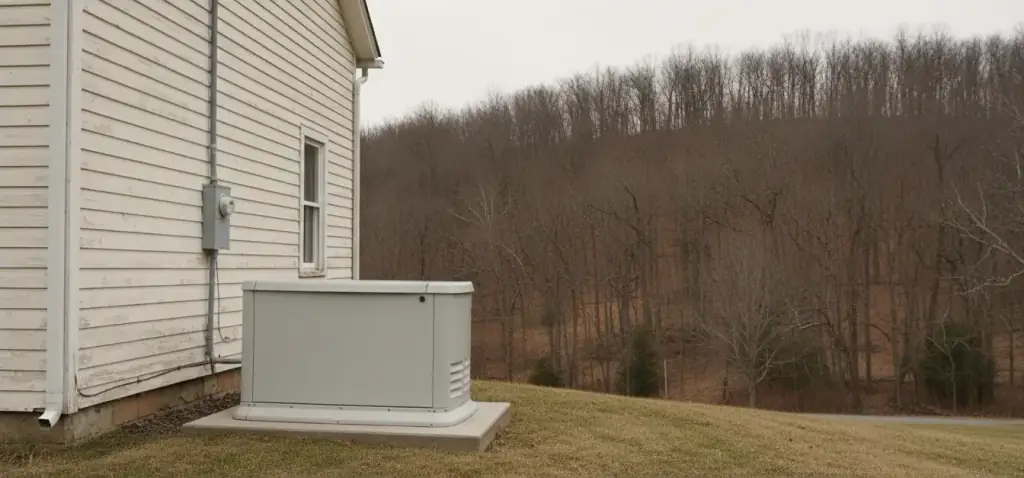
Storms move through the Delaware River valley the way they always have, and when the lines go down out here it can take longer to get power back than it does closer to town. A generator isn't a luxury item on a lot of these properties. It's the thing that keeps the well pump running so there's water, keeps the sump pump running so the basement doesn't flood, and keeps the heat on when it's cold outside.
The question most people actually have isn't whether they need a generator. It's what size, and what it will and won't carry when the power is out for a day or three.
Without one, an outage on a rural property is a different problem than it is in town. A house on municipal water still has water when the lights go out. A house on a well doesn't, because the pump that pulls water up needs power to run. The same goes for the sump pump in the basement, which tends to matter most in exactly the kind of storm that knocked the power out in the first place. Add a freezer full of food, a security system that goes dark, and a furnace that can't run its blower even if the burner still has fuel, and a short outage turns into a genuinely disruptive few days.
What a properly sized unit actually keeps running
An automatic standby generator sits outside the house, on a pad, wired into the electrical system through a transfer switch. When utility power drops, it starts on its own, usually within seconds, and the transfer switch moves the house load over to the generator automatically. Nobody has to run outside in the rain to start it.
- Air conditioning and heat, so the house stays livable through a long outage
- The sump pump, which matters most exactly when a storm is the reason the power is out
- The well pump, since no power usually means no water on a well system
- Security systems, so the house isn't dark and unmonitored
- Large appliances, so the refrigerator and freezer don't lose what's in them
Automatic standby or a portable hookup
Not every property needs the full automatic setup right away. We also install hookups that let a portable generator feed the house safely through a transfer switch, rather than running extension cords through a window, which is how people get hurt or damage equipment. It's a reasonable middle step, and some homeowners use it for a season or two before deciding to go automatic.
An automatic unit also has to run on something, and most properties already have an answer sitting there without much thought: a natural gas line if the house has one, or a propane tank if it doesn't. We look at what's already on the property before recommending a unit, rather than assuming one fuel type over the other. Either way, an automatic standby generator commonly runs a short self-test on its own schedule, a few minutes every week or two, so it isn't sitting idle for months between the one time a year it actually gets called on.
Sizing it to the property, not the other way around
The generator has to match the house, not the other way around. A place with a well pump, a couple of sump pumps, and central air draws differently than a smaller house with baseboard heat and a shallow well. We walk the property, look at the panel, and talk through what has to stay on no matter what and what can wait. That conversation is part of the free estimate, not an extra step tacked on afterward.
Servicing what's already there
We're a Certified Generac Service Dealer, which means if you already have a Generac unit installed by someone else, we can service it too, not just sell you a new one. A generator that's never been serviced is a generator you're trusting without checking, and the worst time to find out it won't start is the night you actually need it.
Placement matters too, more than people expect before they've looked into it. An outdoor unit needs a clear pad, some distance from windows and doors so exhaust isn't drawn back into the house, and enough room around it for airflow and for a technician to service it later without climbing over shrubs or firewood. We help work that out during the same visit as the sizing conversation, so the pad goes in the right spot the first time.
Chestnut Ridge Electric has been doing this kind of work out of Upper Black Eddy since 2003, on both sides of the Delaware. Estimates on generators are free. If you want to talk through what a standby unit would actually keep running at your place, call the office at 610-982-5615.
Chestnut Ridge Electric, 610-982-5615
Call 610-982-5615More articles
Is Your Electrical Service Big Enough for What You Actually Run
A panel that was fine for decades can fall short the moment a house adds central air, a hot tub, or a workshop full of tools.
Roof or Ground: Deciding Where Solar Panels Actually Go
Roof or ground mounted solar panels aren't just a style choice. The site itself usually decides which one makes more sense.