Roof or Ground: Deciding Where Solar Panels Actually Go
Roof or ground mounted solar panels aren't just a style choice. The site itself usually decides which one makes more sense.
September 23, 2026 · 3 min read
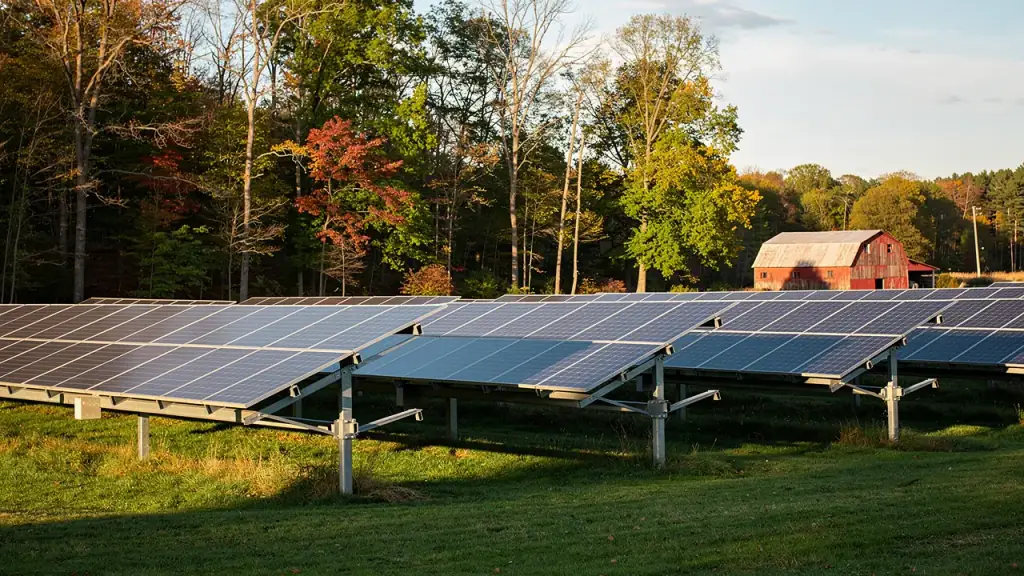
Most people picture solar panels on a roof, and for a lot of houses that's exactly right. But a good number of the properties out here have enough open land that a ground mount is worth considering too, and the two options aren't just a style choice. They change how the system performs and how it gets installed.
We install both, and the site itself usually makes the decision easier than people expect.
Either way, the electrical side of the job is the same in principle: panels generate power, an inverter converts it to something the house can actually use, and it ties into the electrical system alongside the utility connection rather than replacing it. The difference between roof and ground is almost entirely in how the panels themselves get mounted and how far the wiring has to travel to reach the house.
The case for a roof mount
A roof mount uses space the house already has, so it doesn't take anything away from the yard or a field. It's usually a shorter run of wiring back to the panel, and on a lot of properties it's simply the more practical option because there isn't open land to spare. The tradeoff is that the panels are stuck with whatever angle and orientation the roof gives them, and shading from trees, a chimney, or a neighboring structure can cut into what the roof would otherwise produce.
The case for a ground mount
A ground mount goes in a field, a cleared corner of a property, or anywhere with open sky. Because it isn't tied to the roof's pitch, it can be angled and oriented for the best possible exposure, which on a good site can mean better output than the same panels would get bolted to a roof. It also keeps the roof itself untouched, which some owners prefer, especially on an older roof they don't want to disturb. The tradeoff is a longer trench for the wiring run back to the house, and it takes up ground that could otherwise be used for something else.
A ground mount also tends to be easier to work on later, since there's no ladder involved and nothing to walk on at height. Clearing snow off a ground mount, or getting to a panel that needs a look, is a different job than doing the same thing on a roof two stories up. On a property with the land to spare, that alone is worth factoring in alongside the output numbers.
Some properties end up doing a bit of both, a partial roof array where the roof cooperates and a smaller ground array to make up the difference where it doesn't. There's no rule that says a solar installation has to be one or the other, just whichever combination actually fits the site and gets the output the homeowner is after.
What actually decides it
- How much unshaded roof area the house has and which way it faces
- Whether there's open land on the property that gets good sun through the day
- The age and condition of the roof itself
- How far a ground mount would need to be trenched back to the panel
We look at the site itself before recommending either one. Sometimes the roof is the obvious answer. Sometimes a field a hundred feet from the house will produce more power for the same number of panels. There isn't a default answer that fits every property.
What it's actually for
The reasons people go solar don't change much: it can lower what the house pays for power, it's a long term investment in the property, and there's usually some kind of incentive available, worth asking about when you get your estimate. It's also, for a lot of homeowners, simply a way to put less strain on the grid and the environment.
None of that is guesswork specific to one property, either. Solar has been installed on commercial buildings as well as houses, and the same site questions, roof condition, available open land, shading, and orientation, apply whether it's a single family home or a larger commercial roof. What changes is the scale of the system, not the logic behind where it goes.
Chestnut Ridge Electric installs solar panels roof or ground mounted, wired by the same crew that handles the rest of the house, and estimates are free. If you're trying to figure out which one makes sense for your property, call the office at 610-982-5615.
Chestnut Ridge Electric, 610-982-5615
Call 610-982-5615More articles
What a Standby Generator Actually Keeps Running
When the power goes out on a country property, the real question is what you want a generator to keep running, not just whether you want one.
Is Your Electrical Service Big Enough for What You Actually Run
A panel that was fine for decades can fall short the moment a house adds central air, a hot tub, or a workshop full of tools.